The SRE Role in 2026: How AI is Killing Alert Fatigue and Creating New Superpowers
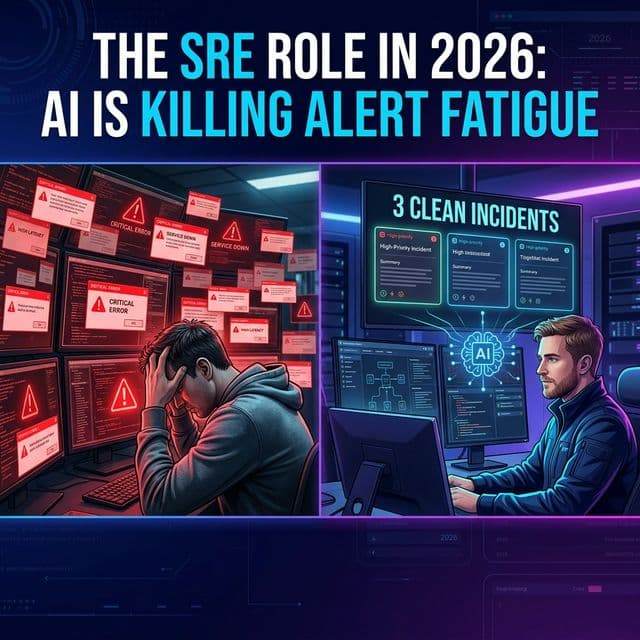
In 2019, I was on an SRE team that received an average of 240 alerts per week. We had 4 engineers. Do the math — that's 60 alerts per person per week. Most were noise. Distinguishing signal from noise at 2 AM is not engineering. It's survival.
In 2026, the same infrastructure would generate 40 actionable incidents per week — after AI correlation, deduplication, and suppression. That's the AIOps revolution happening right now, and it's changing what it means to be an SRE.
WHAT AIOPS ACTUALLY MEANS IN PRACTICE
AIOps is not a product you buy. It's a layer of intelligence applied to your existing observability stack. Let me explain the three mechanisms that are most impactful:
1. Anomaly Detection (The Watchdog Problem)
Traditional alerting: you set a threshold (CPU > 80% for 5 minutes). Problem: you don't know what "normal" is for every service, at every time of day, on every day of the week. AI anomaly detection learns your baseline and alerts when something is statistically unusual, not just threshold-breached.
2. Alert Correlation (The Avalanche Problem)
When a DNS failure cascades, you don't get one alert. You get 200. AI correlation identifies these as one incident — the DNS failure — and pages you once with the correlated evidence.
3. Predictive Alerting (The Foresight Problem)
AI can now predict failures before they happen. Disk filling 8 hours from now. Memory pressure trending toward OOM in 3 hours. Forecasting-based alerts give SREs time to act, not just react.
THE NEW SRE SKILL STACK IN 2026
What SREs Are Spending More Time On (and Being Paid More For):
- SLO Engineering: Designing meaningful SLOs, error budgets, and reliability contracts.
- Chaos Engineering: Deliberately breaking systems in controlled ways.
- Observability Architecture: Designing the telemetry strategy so AI tools have the data they need.
- AI Tool Integration: Evaluating, implementing, and tuning AIOps tools.
THE SRE CAREER PATH IN THE AI ERA
The best SREs in 2026 are not the ones who can diagnose an incident the fastest — AI is closing that gap. They're the ones who design systems that are easy for AI to diagnose. Structured logs. Rich distributed traces. Semantic metrics. Good SLOs. These aren't just engineering hygiene — they're the interface between your system and your AI tooling.